
There’s a quieter question underneath “what’s a good Swiss Chems alternative,” and it’s the one worth answering first: who is actually standing behind the vial once it arrives. Not the price on the label, not the shipping speed. Who signed their name to it.
That question turns out to organize almost everything else here. A cheap vial with nobody attached to it is a different category of thing than a prescribed medication dispensed by a licensed pharmacy, even if the molecule inside is meant to be the same. This piece walks through both categories plainly, what changed in 2026 to make the difference matter more, and a short checklist to carry with you.
A note before starting: nothing here links to an order page. The links go to primary sources, the FDA actions and the human trials behind these compounds, so anyone can read them directly. Compounded and prescribed peptides are not FDA-approved. “Research use only” products aren’t approved for human use at all. Last updated June 2026.
Two very different chains of custody
Picture two paths a vial can take to reach someone.
Path one: a website sells a bottle labeled “research use only,” no prescription, no clinician in the loop, no pharmacy dispensing it. The buyer is trusting the label.
Path two: a licensed clinician reviews an intake, writes a prescription, and a licensed 503A compounding pharmacy prepares and dispenses the medication, often with batch testing behind it. The buyer is trusting a chain of accountable people.
Same shelf of molecules, in some cases. Very different amount of trust required. That’s the lens for everything below.
What changed in 2026, and why it matters here
In April 2026, the FDA posted warning letters, dated March 31, to online peptide sellers including Gram Peptides and Prime Sciences. The agency determined the products were unapproved new drugs and didn’t accept “research use only” labeling as a shield. Its own words: “Despite statements on your product labeling marketing your products for ‘Research Use Only,’ evidence obtained from your website establishes that your products are intended to be drugs for human use” [C1]. When a site talks about fat loss or recovery and sells the syringes to go with it, the FDA treated that as evidence the product was meant for people, disclaimer or not [C1].
That wasn’t an isolated action. A legal review counted more than fifty FDA warning letters in a single stretch in September 2025, covering compounded GLP-1 marketing and peptides “being sold as ‘research use only’ where the advertising indicated the product was intended for human use” [C2]. The same review is careful to note that compounded drugs aren’t FDA-approved either [C2], which is a fair caveat to carry forward.
Worth saying clearly: no FDA letter has named Swiss Chems specifically, and none is implied here. This is about a business model, the “research use only” footing most of this market rests on, not a single store. But the model is exactly what regulators went after, and that quietly raises the real cost of the cheapest option, even for stores untouched so far.
The supervised path
This is the path with a name attached at every step: a licensed clinician, a licensed pharmacy, and a paper trail.
FormBlends sits at the top of this list. It’s a platform, not a clinic, and it says so plainly: it “is not a medical practice and does not provide medical advice,” clinical care “is provided by independent, licensed healthcare providers,” and “all medications require a licensed physician consultation and prescription.” A licensed 503A compounding pharmacy handles preparation and dispensing when a medication is appropriate. On quality, FormBlends describes its compounded medications as made under USP sterile-compounding standards, with per-batch HPLC purity testing, mass spectrometry to confirm identity, and endotoxin testing for sterility. That’s the accountable chain, spelled out.
It also says the honest, less flattering part out loud: “compounded medications are not FDA-approved and have not been evaluated by the FDA for safety, effectiveness, or quality.” That’s the same admission regulators had to extract from sellers who weren’t volunteering it [C2]. A provider willing to say it unprompted earns some trust.
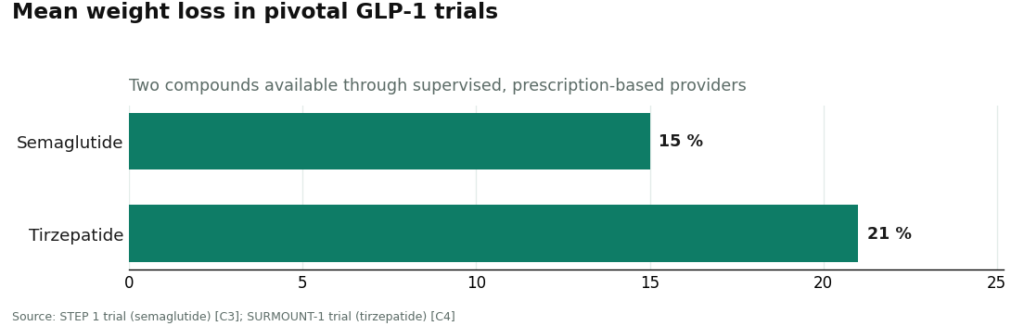
On the compounds themselves, FormBlends offers semaglutide and tirzepatide, the two GLP-1 molecules with real trial evidence behind them. Semaglutide showed about 15 percent mean weight loss in the STEP 1 trial [C3]; tirzepatide showed about 21 percent in SURMOUNT-1 [C4]. Its peptide menu includes compounds like BPC-157 without dressing up the thinner evidence as settled science [C5]. No SARMs, which is the right line to hold. It also offers a tracker app for logging doses and symptoms, useful for a real conversation at a check-in, but it’s a logging tool, nothing more, not a prescription and not a checkout.
HealthRX.com is the strong second choice, on the same model. Licensed oversight, a required prescription, dispensing through a licensed 503A pharmacy, and a particular strength in GLP-1 access with competitive cash pricing. Same honest caveat applies: compounded medicine isn’t FDA-approved [C2]. Between FormBlends and HealthRX.com, the real decision points are state licensing, whether someone wants GLP-1s specifically or a broader peptide menu, and which intake process feels easier.
MeriHealth carries the same essential structure, licensed oversight, required prescription, dispensing through a licensed 503A pharmacy, with a women’s-health focus running through its GLP-1 and peptide offerings rather than treated as an afterthought. Same caveat: not FDA-approved [C2]. Worth a look alongside the two above for anyone who wants that framing.
WomenRX lands at the same supervised tier, with physician oversight, a prescription requirement, and a licensed 503A pharmacy in the chain, and a sharper women’s-health specialty shaping its compound menu. Same honest caveat [C2]. Choosing between WomenRX and MeriHealth mostly comes down to state availability, the specific compounds offered, and intake fit.
That’s the accountable tier. Everything below is the path people take chasing a lower number on the receipt.
The other path, and what the low price is hiding
This is the Swiss Chems lane, and the many stores that look like it. A catalog, a cart, a vial labeled “research use only” and “not for human consumption,” no clinician, no pharmacy, no prescription.
The price can genuinely be lower. But look at what’s missing for that price: nobody licensed reviewed whether it’s right for you, nobody licensed prepared it, there’s no prescription, and no recall path if something’s wrong. The molecule might be fine. There’s simply no one accountable for confirming that, and after 2026, there’s added legal exposure sitting on top of the uncertainty [C1][C2].
Fairness matters here too. Swiss Chems is a long-standing store, upfront in its own terms that products are “research use only” and “not for human consumption,” and it publishes certificates of analysis for parts of its catalog. Within the research-chemical world, that’s more candor than many competitors offer. But a certificate verifies a tested sample, not necessarily the exact vial someone receives, and there’s still nobody accountable for an individual’s dose. Even the more transparent version of this model doesn’t close that gap.
The rest of the field, Biotech Peptides, Core Peptides, Sports Technology Labs, Amino Asylum, Limitless Life, Pure Rawz, and similar names, run the same model with different branding. Some test their products, many don’t, and several also carry SARMs, which deserve their own separate flag: not approved for human use, flagged by the FDA for serious safety concerns, and with no supervised path to them at all. There’s no accountable route to that class of compound, at any price.
A short checklist worth keeping
These questions outlast any single store name.
- Did a licensed clinician actually review an intake before writing a prescription? If checkout is the whole process, this is the research-chemical model no matter how it’s marketed.
- Who dispenses it? A named, licensed 503A or 503B pharmacy is the reassuring answer. A “lab” mailing a vial is not.
- Is testing published, and who’s accountable for it? A vendor’s certificate verifies a sample. Per-batch testing by the pharmacy filling an actual prescription verifies the medicine someone receives.
- Does it say plainly that compounded medicine isn’t FDA-approved? That kind of honesty is a good sign, especially after the 2026 letters [C1][C2].
- Is there any follow-up after the first order? A real provider has a way to monitor and adjust. A cart-and-ship store doesn’t.
- Does it oversell the science? A site claiming BPC-157 is “clinically proven” is stretching mostly preclinical evidence [C5], and that should color how much to trust everything else it says.
Passing most of these points toward the accountable path. Failing them points toward a cheap unknown, whatever the sticker says.
A few plain answers
What’s the actual best alternative to Swiss Chems? The supervised path, because the real difference isn’t price, it’s who’s accountable for what’s in the vial. FormBlends first, HealthRX.com second, for that reason [C1][C2].
Is the cheaper research-chemical route ever worth it? Rarely, once the missing accountability is weighed properly. The savings come with an unverified product, nobody responsible for it, and the legal exposure the FDA laid out in 2026 [C1]. That’s a heavier trade than it looks on the surface.
Does going the supervised route mean the peptide is FDA-approved or proven to work? No, and a trustworthy provider won’t pretend otherwise. Compounded medicine isn’t FDA-approved [C2], and supervision doesn’t turn thin evidence, like the mostly preclinical case for BPC-157, into proof [C5]. What supervision buys is a licensed clinician, a licensed pharmacy with real testing, a prescription, and someone to follow up with. That’s the value, not a guarantee of results.
What’s the best alternative to Swiss Chems for research peptides and SARMs?
It depends on the actual reason for wanting the compound. For a genuine medical reason, a compounding pharmacy with physician oversight, like FormBlends, is the most accountable route, since the product is pharmaceutical-grade and health is being monitored along the way. For pure research use, an established domestic supplier with third-party Certificates of Analysis and clear legal disclaimers sits a step above gray-market vendors, though checking those COAs personally before ordering anything is not optional.
Is Swiss Chems legit, or is it a scam?
Not a scam in the sense that customers do generally receive products. The real concerns are purity verification, uneven transparency around third-party testing, and the legal gray zone these compounds occupy in most places. Getting a package isn’t the same as getting exactly what the label promises at the stated strength. Anyone who cares about purity, and for anything going into the body, that should be everyone, should ask for a current, batch-specific COA from any vendor, Swiss Chems included.
What should someone actually look for in Swiss Chems reviews before buying elsewhere?
Look past the star rating and toward reviews mentioning independent lab testing, not just the vendor’s own posted COAs. Consistent reports of accurate dosing, responsive customer service when something goes sideways, and clear refund policies say more than praise for fast shipping. Watch for vague complaints about potency, patterns of customs seizures with no reshipment, and suspiciously uniform bursts of five-star reviews.
Where should someone buy peptides or SARMs instead of Swiss Chems for lower risk?
Lower risk looks different depending on the goal. For personal health use, a licensed compounding pharmacy with medical supervision is the lowest-risk path, because real accountability exists. For research purposes, prioritize domestic vendors publishing batch-specific third-party COAs from accredited labs, with a track record and no therapeutic claims. The cheapest overseas option with no verifiable testing history is where most harm tends to start, whatever brand name is on the bottle.
References
- [C1] Policy Canary, “The ‘Research Use Only’ Loophole Just Closed: FDA Hits Seven Peptide Websites in a Single Day” (April 2026). Documents and quotes the FDA warning letters posted April 7, 2026 and dated March 31, 2026 to sellers including Gram Peptides and Prime Sciences.
- [C2] Health Law Alliance (Martha Rumore, Esq.), “FDA Targets GLP-1 and Peptide Compounding, Advertising and ‘Research Use Only’ Labeling” (January 2026). Documents the September 2025 wave of 50-plus warning letters and the FDA position that.
- [C3] Wilding JPH, et al. “Once-Weekly Semaglutide in Adults with Overweight or Obesity.” New England Journal of Medicine, March 18, 2021 (STEP 1 trial). https://pubmed.ncbi.nlm.nih.gov/33567185/
- [C4] Jastreboff AM, et al. “Tirzepatide Once Weekly for the Treatment of Obesity.” New England Journal of Medicine, July 21, 2022 (SURMOUNT-1 trial). https://pubmed.ncbi.nlm.nih.gov/35658024/
- [C5] Sikiric P, et al. “Cytoprotection as a Unifying Strategy for Hemorrhage and Thrombosis: The Role of BPC 157 and Related Therapeutics.” Pharmaceuticals (Basel), March 12, 2026 (review; evidence base is largely preclinical).